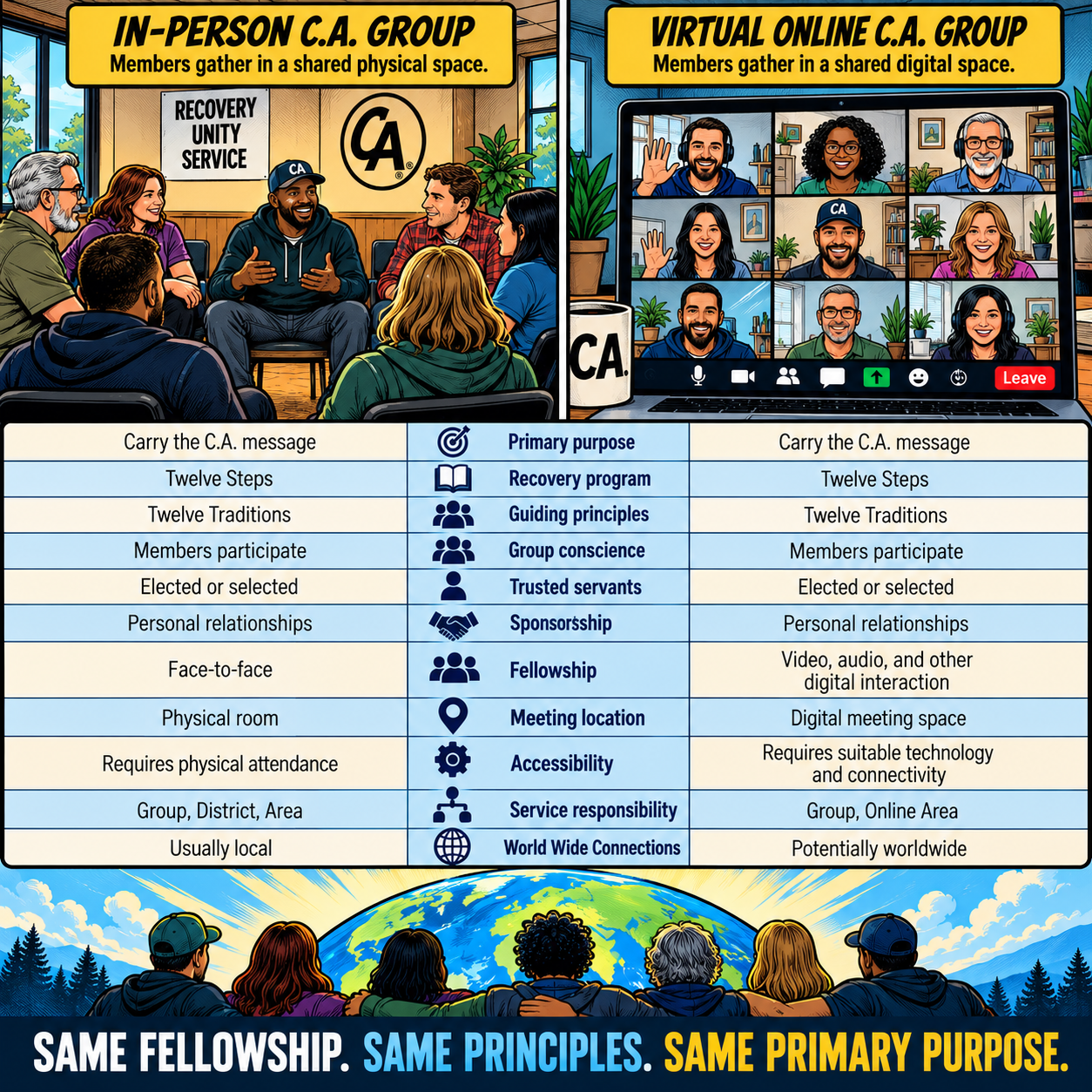
A case for recognizing Virtual Online Groups, Multiple Online Areas, and a C.A. Online Region within Cocaine Anonymous.
The distinction between an in-person C.A. meeting and a virtual online C.A. meeting is not one of purpose, principles, membership, or message. It is fundamentally a distinction in the medium through which the Fellowship carries its message of recovery.
Both exist to fulfill the same primary purpose: carrying the message to the addict who still suffers.
Both rely upon the Twelve Steps, Twelve Traditions, and Twelve Concepts of Cocaine Anonymous. Both provide opportunities for identification, sponsorship, fellowship, service, and spiritual growth.
An in-person group gathers in a physical location. An online group gathers in a virtual location. Neither the physical room nor the digital platform defines the recovery taking place within it.
The meeting place is not the Fellowship. The people, their shared experience, and their common purpose constitute the Fellowship.
This distinction is particularly important when considering whether multiple Virtual Online Areas and an Online Region should be recognized within the C.A. service structure.
1. Comparing the in-person group and the virtual online group
In-person C.A. group: Members gather in a shared physical space.
Virtual online C.A. group: Members gather in a shared digital space.
Same fellowship. Same principles. Same primary purpose.
The similarities are fundamental to C.A.’s identity. The differences are primarily practical and operational.
Online meetings do introduce distinctive challenges involving technology, privacy, time zones, international participation, and group accountability. However, these challenges concern how the group operates, not whether it is a legitimate C.A. group.
2. The medium does not determine the legitimacy of the message
Consider the historical evolution of communication within Twelve-Step fellowships.
Recovery messages have been carried through personal conversations, printed literature, telephone calls, recorded speaker meetings, and now internet-based communication. Each development has expanded the ways members can communicate their experience, strength, and hope. Yet none of these communication methods changes the fundamental recovery principles being communicated.
A member sharing their experience across a table and a member sharing that same experience through a computer screen are performing essentially the same act of service.
- The important questions are not whether members occupy the same physical space, but whether:
- The group’s primary purpose is to carry the C.A. message.
- The group practices the Twelve Traditions.
- Members have opportunities to participate in group conscience and service.
- The group maintains responsibility and accountability to the Fellowship.
- The newcomer can encounter the C.A. solution.
If a virtual group fulfills the same spiritual and organizational responsibilities as an in-person group, the absence of a physical meeting room should not, by itself, diminish its standing within Cocaine Anonymous.