How does the C.A. Fellowship, historically organized around geographic Areas, accommodate online groups whose members and service responsibilities transcend geographic boundaries?
“The Conference may also recognize Areas whose boundaries do not fit a geographic description.
— 2026 CA World Service Manual, p. 26
This suggests that the existing definition can accommodate a Virtual Online Area without necessarily requiring an entirely new definition of an Area.
The distinction: Geography versus service responsibility
Historically, geographic boundaries helped determine which groups belonged to an Area and how those groups pooled resources to provide services.
A Virtual Online Area presents a different organizational model. Its boundaries are not determined by where members live, but by which online groups have voluntarily joined together for the purpose of providing collective services.
|
Traditional Geographic Area |
Virtual Online Area |
| Boundaries generally defined by geography | Boundaries defined by participating online groups |
| Groups typically serve members in a geographic region | Groups serve members internationally |
| Members may attend local meetings | Members participate regardless of physical location |
| Groups pool resources for common services | Online groups pool resources for common services |
| Area facilitates Fellowship unity | Virtual Area facilitates Fellowship unity |
| Area sends a World Service Delegate | Recognized Virtual Area would send a World Service Delegate |
The underlying service purpose remains essentially the same. What changes is the means by which groups associate and cooperate.
Proposed Definition: Virtual Online Area
A Virtual Online Area is a non-geographic service entity composed of a suggested 2 or more registered virtual online Cocaine Anonymous Groups that voluntarily associate to pool their collective experience, resources, and service efforts.
Unlike a geographically defined Area, a Virtual Online Area’s boundaries are established through the voluntary affiliation of its participating Groups rather than the physical location or residence of their members.
The fundamental problem is not that Virtual Online Areas overlap Geographic Areas. It is that the existing service structure may not adequately distinguish between a member’s participation in meetings and a group’s representation in the C.A. service structure.
Those are two very different things.
1. Geographic overlap is not necessarily a conflict of jurisdiction
A Geographic Area generally defines its boundaries by physical location. A Virtual Online Area defines its boundaries by the affiliation of its participating groups.
Consider a C.A. member living in Toronto who attends a local in-person group and also participates in an online group affiliated with an international Virtual Online Area.
The primary function of a Virtual Online Area is to serve the common needs of its participating Groups, facilitate communication and cooperation, encourage unity within the Fellowship, and carry the message of Cocaine Anonymous through virtual online environments.
A Virtual Online Area operates in accordance with the Twelve Traditions and Twelve Concepts of Cocaine Anonymous and, upon recognition by the World Service Conference, participates in the established World Service structure, including representation through a World Service Delegate.
The central issue: What constitutes an Area’s boundaries?
There are four important considerations:
- Group affiliation rather than geographic location. An online group could affiliate with a Virtual Online Area regardless of the country in which its members reside.
- Group autonomy. Participation in a Virtual Online Area should be voluntary and consistent with the group’s autonomy under Tradition Four.
- Service rather than territorial jurisdiction. A Virtual Online Area need not claim exclusive authority over online meetings or members within a particular country or region.
- World Service representation. Once recognized by the Conference, the Virtual Online Area would have the same fundamental service responsibilities and representation rights as other recognized Areas, subject to applicable Conference rules.
An important distinction
A Virtual Online Area is not necessarily an Area without boundaries. It is an Area whose boundaries are organizational rather than geographical.
That distinction is central to explaining how a Virtual Online Area fits within the existing C.A. service structure.
There is also a question I would examine carefully: Does the requirement for ten or more groups come from an existing C.A. World Service policy, a proposed qualification for Virtual Online Areas, or the practical experience of groups organizing themselves?
That matters because it distinguishes the right of groups to organize collectively for service from the Conference’s authority to recognize an Area for World Service representation.
The central issue facing the Cocaine Anonymous World Service Conference:
Is the purpose of an Area to provide a geographic or organizational home for groups, or is its purpose to serve the collective needs of groups that voluntarily choose to associate with one another?
The distinction is fundamental.
The delegates who suggest that all new online groups should join the one existing Online Area are approaching the question from the perspective of administrative efficiency and avoiding duplication.
The groups wishing to establish a second or third Virtual Online Area are approaching the question from the perspective of group autonomy, service participation, and the ability to develop service structures responsive to their particular needs.
Both perspectives deserve consideration. However, the existence of one recognized Online Area does not, by itself, establish that additional Online Areas are unnecessary.
1. The central argument: One Online Area does not necessarily serve every online group
Consider a parallel question:
If Cocaine Anonymous already has a recognized geographic Area in one region, does that mean every new group in that region must forever belong to that Area?
Not necessarily. As the Fellowship develops, new service structures may emerge when groups determine that their common needs can be served more effectively through a different organizational arrangement.
The same reasoning can apply to virtual online groups.
The internet is not one community simply because everyone uses the same technology.
Online groups can differ considerably in their service needs, meeting cultures, languages, schedules, accessibility requirements, and approaches to carrying the message.
The fact that groups meet online is a characteristic they share. It does not automatically mean they have identical service needs.
2. The 2026 World Service Conference makes this an immediate issue
The historical account on the Online Recovery Area website reports that the Online Recovery Area and the Online GB Area both sought recognition at the September 2026 World Service Conference and were denied.
The existing Online Service Area was recognized in 2000 and is now known as the Online International Area.
That history makes it particularly important to distinguish the reasons for denying recognition from the broader question of whether multiple online Areas should be permitted.
3. What the World Service Manual actually says:
The official C.A. World Services website confirms that the Conference may recognize non-geographic Areas and that new Areas must petition for recognition. It also describes the primary function of an Area as serving the common needs of its Groups and Districts.
Notice what this definition does not expressly say:
- It does not establish a limit of one non-geographic Area.
- It does not say that every online group must join the first recognized Online Area.
- It does not require every online group to share the same service priorities.
- It does not make the existence of another Area an automatic reason to reject a petition.
This does not mean recognition is automatic. The Conference retains the responsibility to evaluate each petition.
But it suggests that the appropriate question is not simply, Why do we need another Online Area? But rather, Have these groups demonstrated a legitimate common service need, a functioning service structure, and the capacity to fulfill the responsibilities of a recognized Area?
4. A possible misunderstanding about unity
Some delegates may understandably see additional online Areas as fragmentation.
But unity and uniformity are not synonymous.
Unity means that groups remain committed to C.A.’s common purpose, Traditions, and Concepts while cooperating in carrying the message.
Uniformity would mean expecting every online group to operate within the same Area structure simply because they use the internet.
A Fellowship can maintain unity while permitting diversity in the ways its groups organize their service responsibilities.
Indeed, multiple Areas could cooperate through inter-Area communication, shared technology, public information initiatives, and service workshops without sacrificing their organizational independence.
5. The legitimate concerns delegates may have
A strong proposal should also answer the concerns of delegates who oppose additional online Areas.
|
Delegate concern |
Question a new Online Area should answer |
| Why duplicate an existing Area? | What distinct or unmet service needs will the proposed Area address? |
| Will this divide the Fellowship? | How will it cooperate with other online and geographic Areas? |
| Will it increase Conference costs? | How will it finance delegates and other service commitments? |
| Will groups be counted twice? | How will exclusive group affiliation and accurate meeting counts be maintained? |
| Will it create excessive voting influence? | How will representation comply with the Conference’s established rules? |
| Is the new Area sustainable? | Does it have participating GSRs, officers, minutes, finances, and ongoing service activity? |
The voting concern is particularly important because C.A.’s delegate allocation rules connect Area representation to meeting counts. The World Service Manual also addresses the need for groups to be aligned with only one Area.
Rather than dismissing these concerns, a new Online Area can demonstrate that it has anticipated and addressed them.
6. The argument I would put before the delegates
Why More Than One Online Area?
A Question of Service, Not Geography
The existence of one recognized Online Area of Cocaine Anonymous does not, in itself, eliminate the need for additional Online Areas.
The C.A. World Service Manual defines the primary function of an Area as serving the common needs of its Groups and Districts and facilitating the unification of the Fellowship.
It also expressly permits the World Service Conference to recognize Areas whose boundaries are not geographical.
The fundamental purpose of an Area, therefore, is not simply to organize meetings within a defined territory. It is to provide a service structure through which groups can collectively fulfill their primary purpose.
Online recovery has transformed the way C.A. members meet, communicate, and carry the message. Groups whose members reside in different countries and time zones can now cooperate in providing services without sharing a geographic location.
As these groups grow, some may discover common service needs, develop shared service priorities, and voluntarily establish new Area service committees.
The existence of an established Online Area does not necessarily mean that all other online groups will find their service needs best fulfilled through that one structure.
Nor should the desire of groups to form another Area automatically be interpreted as disunity or competition.
The creation of another Area can represent an expansion of service rather than a division of the Fellowship.
The question before the World Service Conference should not be whether one Online Area already exists.
The question should be whether the petitioning groups have demonstrated the need, willingness, organizational capacity, and collective responsibility to function as an Area in accordance with the Twelve Traditions, Twelve Concepts, and established World Service requirements.
The Conference has both the authority and responsibility to examine those qualifications.
Recognizing additional qualified Online Areas would not require abandoning the principles upon which C.A.’s service structure was established.
It would represent the application of those same principles to an evolving Fellowship.
Our common purpose does not require every group to share the same Area. It requires every Area to serve that common purpose.
7. Strategy for the next Conference
Rather than making the case that new online groups have a right to form another Area, this petition will concentrate on demonstrating that new online service structures are already functioning, meeting identifiable needs, and contributing to the Fellowship’s primary purpose. Thus, Delegates can evaluate demonstrated service rather than organizational preference.
Three questions:
- Whether the groups are free to organize for collective service?
- Whether they satisfy the criteria for Conference recognition?
- Whether the Conference should recognize their particular petition?
The 2026 Conference’s refusal to recognize two additional Online Areas presents an opportunity to establish clearer and more consistent criteria for non-geographic Area recognition.
Further Exploration:
The fundamental problem is NOT that Virtual Online Areas overlap Geographic Areas, but rather that the existing service structure may not adequately distinguish between a member’s participation in meetings and a group’s representation in the C.A. service structure.
Those are two very different things.
1. Geographic overlap is not necessarily a conflict of jurisdiction
A Geographic Area generally defines its boundaries by physical location. A Virtual Online Area defines its boundaries by the affiliation of its participating groups.
Consider a C.A. member living in Toronto who attends a local in-person group and also participates in an online group affiliated with an international Virtual Online Area.
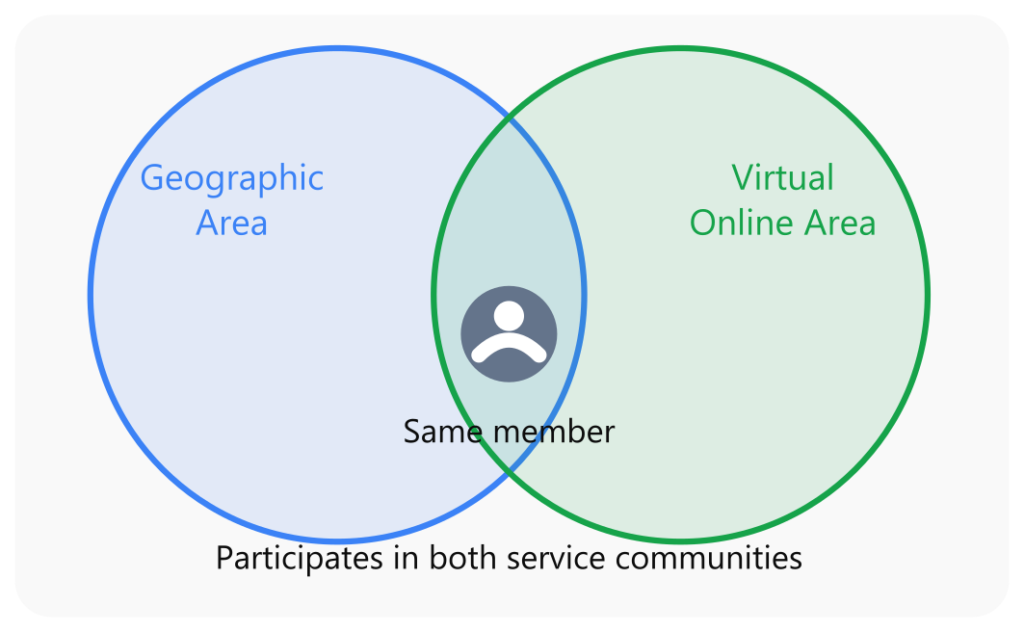
The member can legitimately attend both meetings. The more difficult question is whether that individual can exercise a vote in both service structures.
This is where the principle of one heartbeat, one vote becomes relevant.
2. Three different forms of participation must be distinguished
|
Delegate concern |
Question a new Online Area should answer |
| Why duplicate an existing Area? | What distinct or unmet service needs will the proposed Area address? |
| Will this divide the Fellowship? | How will it cooperate with other online and geographic Areas? |
| Will it increase Conference costs? | How will it finance delegates and other service commitments? |
| Will groups be counted twice? | How will exclusive group affiliation and accurate meeting counts be maintained? |
| Will it create excessive voting influence? | How will representation comply with the Conference’s established rules? |
| Is the new Area sustainable? | Does it have participating GSRs, officers, minutes, finances, and ongoing service activity? |
The risk of double representation is real, but it is not exclusive to Virtual Online Areas.
A member can attend two in-person groups in different Geographic Areas, or participate in two groups within the same Area.
The internet makes this situation more visible and easier to encounter, but it did not create the underlying question.
3. The critical distinction: A member is not the same as a group
Under a representative service structure, groups participate in Area decisions through their designated representatives.
That creates two distinct voting situations:
At the group level: A member’s voting participation is governed by that group’s established group-conscience practices.
At the Area level: The group exercises its collective voice through its authorized representative, subject to the Area’s rules.
If a member participates in two groups, that does not automatically mean one group has been counted twice.
But if the same person exercises two votes on the same Area question, or if one group is represented in two Areas, there may be a genuine governance problem.
The distinction is between multiple participation and duplicate representation.
4. A possible framework for preventing duplicate representation
The following principles are suggested as potential policy guidelines, rather than treating them as existing C.A. rules:
- One group, one Area affiliation. Every registered group, whether online or in-person, affiliates with only one recognized Area for World Service representation.
- One authorized representative per group vote. Each group exercises its Area-level vote through the representative authorized under the applicable service rules.
- No duplicate group counting. A group cannot be included in the delegate-allocation calculations of two different Areas.
- Clear eligibility for Area service positions. Each Area establishes transparent rules, consistent with World Service policy, addressing simultaneous offices and voting responsibilities.
- No geographic exclusivity for online membership. A member’s physical residence does not automatically determine which online group they may attend or serve.
The third safeguard is particularly important because it protects the integrity of Conference representation.
5. A possible statement for delegates and Trustees
Virtual Online Areas, Geographic Overlap, and the Principle of One Heartbeat, One Vote
The emergence of Virtual Online Areas raises legitimate questions concerning geographic boundaries, group representation, and the principle of one heartbeat, one vote.
These questions deserve careful consideration. However, they should not be confused with the question of whether additional Virtual Online Areas may legitimately exist.
A Virtual Online Area does not claim jurisdiction over the physical territory occupied by a Geographic Area. Its service responsibility arises from the voluntary affiliation of its participating online groups.
Likewise, a member’s participation in both an online group and an in-person group does not necessarily constitute duplicate representation.
A distinction must be maintained between individual participation in the Fellowship, participation in group conscience, and the formal representation of groups within the World Service structure.
The principle of one heartbeat, one vote should protect the integrity of collective decision-making. It should not be interpreted in a manner that unnecessarily restricts members from participating in multiple recovery communities.
To preserve representative integrity, each group should be affiliated with only one Area for World Service purposes and should be counted only once in determining Area representation.
Additional guidelines may be developed to address simultaneous service positions, voting eligibility, and potential conflicts of representation.
These guidelines should apply consistently to Geographic and Virtual Online Areas.
The existence of overlapping membership does not, by itself, establish that two Areas exercise overlapping jurisdiction.
Geographic boundaries define where a traditional Area serves. Voluntary group affiliation defines whom a Virtual Online Area serves.
Both structures can coexist while respecting the same Traditions, Concepts, and principles of accountable service.
The objective should not be to restrict the growth of online service structures, but to establish fair and consistent rules that protect the integrity and unity of Cocaine Anonymous as a whole.
6. Further Questions to Explore:
I suspect that the delegates’ concern may involve something deeper than an individual voting twice at an Area meeting.
Imagine that a member participates in a geographic group and a virtual group. Each group sends a GSR to its respective Area. Each Area subsequently sends delegates to the World Service Conference.
Both groups have contributed to the selection of Conference representatives, and the same individual may have participated in both group consciences.
Does that constitute two votes by one member, or two legitimate group consciences participating in a representative service structure?
That is the conceptual problem that Conference may wish to resolve.
And it leads to a very specific question:
When delegates and Trustees invoke “one heartbeat, one vote,” are they referring to an existing written C.A. World Service rule that prohibits a member from voting in more than one group conscience, or are they applying a general principle to the emerging Virtual Online Area structure?
The answer matters enormously. If it is a written rule, we need to interpret its actual wording. If it is an established principle without a precise rule governing cross-Area participation, the Conference has an opportunity to clarify it without unnecessarily restricting the formation of additional Virtual Online Areas.